

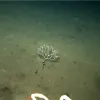
Stony corals are the main reef-builders in oceans and can form miles-long reefs in shallow water and in the deep sea. What looks to be one coral is actually a collection of individual “polyps”, or small tentacles which grow in a crown-like structure out of a round corallite skeleton. Polyps fuse together to form one body, with each unit acting as a sort of mouth that ingests nutrients to share within the coral. Some polyps have stinging cells to stun prey swimming by! Since coral reefs support a quarter of all marine diversity, studying the variety of stony corals that live across all depths is especially important. Shown here is a deep-sea coral ecosystem off the coast of Puerto Rico. While many of the white fan-shaped corals look similar, they are actually several different species. These deep-seafloor, or benthic, corals in their habitat look similar, but need to be collected and examined in greater detail to identify the different species present.
Describing New Deep-Sea Corals and Sponges
Down in the deep ocean lies a host of unknown diversity that scientists at the Smithsonian National Museum of Natural History are working every day to catalogue and describe. From carnivorous sponges to stony corals, these unique animals inhabit the deep seafloor environments and are the building blocks supporting diverse communities. Sponges and corals provide habitats for other animals in the deep by building structure through reefs, filtering water, and providing nutrients to other animals and bacteria. Finding corals and sponges on the seafloor usually means the ecosystem is healthy— lots of other deep-sea life will be found nearby. By searching for and cataloging the species of corals and sponges that live there, scientists can understand the health of the other animals that interact with them. But due to the challenges of working in the deep sea, describing coral and sponge diversity can be difficult and frequently involves describing species new to science.
Scientists use two main tools to tell the difference between species: DNA, or genetic data, and physical traits, like color, shape, and size. In sponges and corals, the overall shape and structure of each species is important, but many species cannot be differentiated without looking at them under a microscope. In sponges, differences between species are found in small structures called spicules. To see these structures, scientists often use powerful microscopes like the scanning electron microscope (SEM) to take scientific photographs of these features. For deep-sea corals, microscopic measurements of features like the diameter and distances between structures called corallites can help scientists tell the difference between two similar looking species.
Scientists in the Museum’s Invertebrate Zoology Department are currently collecting and describing sponges and corals from the U.S. Gulf coast to help restoration efforts in the deep sea following the Deepwater Horizon oil spill. Since many of these collected corals and sponges are new to science, scientists must carefully measure all the physical, or “morphological,” traits of each of these new species. This work helps to accurately characterize what species live in these affected habitats so that they can be restored.







Deep Coral Reefs: Cities Under the Sea
Credit: Courtesy of the Schmidt Ocean Institute- expedition FKt230417
New Animals from the Deep
Credit: NOAADeep sea sponges come in an array of shapes, sizes, and colors throughout the ocean floor. This sponge is a new species (description in prep) and was found rooted in a sandy seafloor off the U.S. Gulf Coast. Notice its unique branching or “fan” shaped structure. Scientists can observe the sponges' general characteristics in their environment before collection by studying images captured by Remotely Operated Vehicles (ROVs). Some features like color are lost after collection, so having images of the living animal is important for accurate species description.

Reaching for animals in the Deep Sea
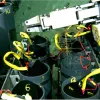
Credit: NOAADeep-sea corals and sponges can grow on rocks, between crevices, sand, or on underwater volcanoes known as seamounts, which makes them difficult to retrieve. Remotely Operated Vehicles (ROVs) are often used to collect specimens from these hard-to-reach locations. After the ROV samples deep-sea sponges and corals from the ocean floor, they are stored in cannisters and transported back to the research vessel for scientists to properly store and preserve in museum collections. Notice the sponge in the ROV hand being placed into a cannister. It is a potential new species of carnivorous sponge collected on the U.S. Gulf Coast.

Entering the Dry Collection
Credit: Monica WheelerThe Smithsonian National Museum of Natural History’s Invertebrate Zoology collection houses thousands of deep-sea coral and deep-sea sponge specimens with some dating as far back as the 1800s. In the collection there are two types of preservation methods: dry-preserved specimens and wet-preserved specimens. Dry specimens are often older items with only preserved hard structures. Coral skeletons are an example of a dry specimen, and they are used to study the coral’s physical characteristics. Scientists are also able to find hidden clues within those coral skeletons that inform us about past ocean conditions.

Diving into the Wet Collection
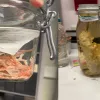
Credit: Samantha Surges and Monica WheelerWet-preserved specimens are just as important as dry-preserved specimens. The Smithsonian’s Museum Support Center holds the Invertebrate Zoology wet collection and has over 18 miles of shelving filled with wet-preserved specimens. These specimens are held in jars of ethanol which maintain the animal’s tissue. This allows scientists to extract DNA now or in the future and helps tell species apart using genetics.

Hard Morphology: Describing Sponge Skeletal Structures
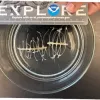
Credit: Samantha SurgesScientists can take samples from wet specimens, enabling them to characterize deep-sea sponge and coral skeletons. After cutting off a tiny piece of the specimen, the soft outer skin can be dissolved, leaving only the skeletal parts of the coral or sponge for observation. In sponges, microscopic glass-like structures called spicules provide the sponges with a skeleton-like structure. Since these spicules have different shapes depending upon the species, they can help scientists differentiate which sponge is which. For coral physical trait identification, after tissues are removed, only their hard skeletons are left.

Tools for Diving Deep into Morphology
Credit: Phillip R. Lee, Smithsonian InstitutionAfter sponge spicules or coral skeletons are prepared, they are thinly coated in metal so that they can be looked at with a SEM. This powerful microscope uses electrons to take images of skeletons that may be smaller than the width of a hair. This allows scientists to not only identify the type of spicule but also take high-quality images for later comparisons against other species.

Tiny Differences Make Species Distinct
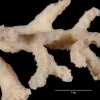
Credit: Katie Ahlfeld, Smithsonian InstitutionDifferences in physical traits across coral specimens are often difficult to see at first glance. White, branching, asymmetrical, hard skeletons dotted with many corallites, like the one seen above, are common traits across stony coral species that have been prepared (and bleached) for observation and measurement. Due to the small size differences in traits, scientists use light microscopes and scanning electron microscopes to zoom into certain features which cannot be accurately measured or even observed by the naked eye. This is one reason why researchers are constantly testing old methods and improving them.

Measuring Microscopic Morphology
Credit: Monica N. WheelerThe section of coral seen here is about the size of a push pin (half an inch). Each of the round crater-like indentations shown on the branch below is called a corallite, the skeleton from which a polyp once grew from when the coral was alive. Morphological features such as the diameter of these corallites and the distances between them (which the blue lines measure) provide information for identifying new species of corals. This photo was captured through a light microscope, and the corallites are about 1/25th of an inch (1.5mm) across.

Uncovering Hidden Features
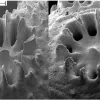
Credit: Monica N. WheelerLooking even closer at each individual corallite through a SEM reveals physical characteristics not previously visible through the light microscope. The SEM projects an electron beam onto a metal-coated sample to focus an image of up to 300,000 times zoom. This technology allows scientists to discover and measure new distinct features in microscopic detail that further help to define a species. Notice the left corallite has a taller outer ridge of protruding walls (known as septa) accompanied by a second shorter set of protrusions located between each tall one, while the right corallite has lower walls that are all the same size. These septa features are one way that taxonomists, scientists that classify and name organisms, use physical traits to tell the difference between two coral species.

Defining a New Species
Credit: Samantha SurgesWhen scientists find an individual they think might be a new species, like the sponge here collected from the U.S. Gulf Coast, fine scale measurements must be recorded. For every new species, there must be a holotype, or a single individual on which the species description is based. Very detailed measurements of a holotype are needed to help define it. For example, on this sponge the length and width of each individual piece, and each branch will be measured. These measurements can be compared against the sizes of other sponges, to help identify the species or determine if it is new to science.

Exploring Spicule Diversity with Microphotography
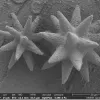
Credit: Samantha SurgesSponge spicules come in a variety of different shapes and sizes. These spicules are “star” shaped and are classified as "oxyasters”. Since spicules are unique to different sponge species, they help scientists identify new and old species alike. Spicules provide skeletal frameworks for support, act as defense against predators, or perform unique functions like prey capture and their shape changes depending upon their function.

Detecting the Small Differences Between Sponge Species
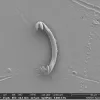
Credit: Samantha SurgesMost sponges passively feed by filtering food particles out of the water, but some deep-sea sponges, known as carnivorous sponges, capture small prey like shrimp-like animals called copepods. Deep sea carnivorous sponges exhibit specific types of hook-shaped spicules known as chela, which you see in this image.Chela helps snare and engulf their prey and helps to delimitate the sponge species belonging to the carnivorous sea sponge family Cladorhizidae.

Dive Deeper
Credit: Image courtesy of NOAA, Oceaneering International, Inc.As scientists continue to explore the mysterious deep sea, more and more is revealed about the corals that live there. For those wanting to learn more, head on over to the Deep-sea Coral page where we discuss coral diversity, reproduction, and reefs as ecosystems.